Pages

Showing posts with label Nilo-Saharan. Show all posts

Sunday, December 9, 2012

THE ANCIENT AFRO-ASIAN LANDSCAPE: DISCOVERY OF AN EARLY GLOBAL AFRICAN CIVILIZATION

AFRO-ASIAN DISPERSALS: How Scholarship has Come Around to the Truth about the Roots of Semitic Speech and Culture 

            by Dana Reynolds


Above are Afro-Asiatic women of the Omotic group. These African-Asiatics began immigrating from Africa thousands of years ago. 

Catal Huyuk stone ruins 

 “As for Palestine, there was no drastic change for the main type during the transition from the Chalcolithic to the Early Bronze Age. Summing up, striking similarities link the physical characteristics of the predynastic Egyptians and of the contemporary Bedja population and the main Berber type and of the Palestinian skeletons of the early Bronze Age.”  From Edward Lipinski’s - Semitic Languages: Outline of a Comparative Grammar, 2001, p.47.
"...the crucial linguistic finding is that the three deepest clades of the Afro-Asiatic family are localized in Eritrea and Ethiopia. All the other languages of the family outside that region belong to subclades of just one of those deep clades. This kind of cladistic distribution is a basic criterion of the genetic argument for the genetic lineage origins well understood by geneticists. It applies to linguistic history as well." (Ancient Local Evolution of African mtDNA Haplogroups in Tunisian Berber Populations). Frigi et al. Human Biology, 82:4, August, 2010)
Dassanech young woman of Ethiopia -  The Dassanech are Omotic-speaking. They speak  an "Afro-Asiatic" dialect 

        It should now be realized by Africans, if by no one else, the global spread of Afroasiatic culture begins much further back than has lately been suspected. The 12th millenium B.C. pre-pottery neolithic (PPN) site of Gobekli Tepe in Anatolia (now modern Turkey ) has now shown clear connections between the earliest cultures of Turkey (such as Catal Huyuk) and those of megalithic Europe and Northern Africa some of which were of course pointed out by scholars over a century ago.  
      One author - Andrew Collins - calling himself a science writer (but more like a pop science writer) has this to say:
    "The main relationship between key PPN sites such as Göbekli Tepe and Nevali Çori is the fact that their layout, design and art are the same. They were constructed by the same unique race of people. They connect with Çatal Hüyük because this was a latter development of the same high culture, and so this city - excavated first in the early 1960s by British archaeologist James Mellaart - can tell us much about the earlier cults at places such as Göbekli Tepe and Nevali Çori. Like, for example, the Neolithic cult of the dead. At Çatal Hüyük we find frescoes of vultures accompanying the soul of the deceased into the next world, and also of shamans taking the form of vultures for presumed shamanic practices, such as contacting or journeying into the other world. Since statues of birdmen, as well as those of vultures, have been found at both Göbekli Tepe and Nevali Çori, we can be pretty sure that the same cult existed here as far back as 11,500-10,000 BP.
       However,  leaving out the comment about a "unique race of people", the truth is that these people of the "high culture" of Catal Huyuk and  pre-pottery Neolithic cultures of the Levant were in fact a link between the very ancient culture of Nilotic northeast Africa, Mesopotamia and the megalithic cultures of western Europe and northern Africa - all for the most part occupied  predominately by a population that has skeletal or morphological affinities and  traits "unique" to the Africans now called "sub-Saharan".
      The discovery of Gobekli Tepe also lends credence to the supposition by some scientists that the pyramid complex and sphinx in Egypt dates back much earlier than is being formally acknowledged and to the supposition by Ehret, Bauval and other open-minded thinkers dating back to Higgins and Massey that the civilization of African-Asiatics was once more widespread and global in nature and more ancient than is presently believed.


"As rightly noted by one interested researcher of early religion - "The stark-naked woman in a very indecent, "splayed", position from Gobekli Tepe (incised on a stone slab covering a bench inside the round wall of a sanctuary 25), is also found at Catal Huyuk....Even the posture of the arms is the same: One arm raised, the other lowered."dn'e ric Langkjer Catal Huyuk and Gobekli Tepe,  https://independent.academia.edu/ErikLangkjer


     After all, some say the Ishango bone tracking lunar phases and purportedly having some connection to the Rhind papyrus in ancient Eygpt dates back some 25,000 or more years ago. These connections, however, are a subject to be discussed in a forthcoming page of this blog. : )


Neolithic man in Catal Huyuk in Turkey (Anatolia) performs cattle jumping ritual similar to modern east Africans. The skeletons of such people have been misnomered "Mediterranean".


 Ancient practices of jumping cattle continue among Africans such as the Omotic-speaking Hamer tribe of Ethiopia


       In order to truly understand the traditions of these ancient cultures which are African and Afroasiatic in origin most of us will have to leave behind the impressions from Western movies and Sunday school or Hebrew school classes that have presented a rather distorted view of who the ancient peoples – especially who people of the Bible were and what they looked like. Scientists who have looked at the ancient world objectively know that the majority, if not all of the early peoples speaking the so-called “semitic” dialects, for example, between 4 and 7 thousand years ago were in fact African and Afro-Asian, predominantly represented by peoples in Africa now speaking "Cushitic" and Nilo-Saharan dialects and once known euphemistically as the “hamites”. (We can probably throw in the Woodabe or early Fulani, Bahima and Watutsi and some other groups now speaking other dialects for good measure.)

Reflecting the appearance of the earliest Semitic-speakers are East Africa's "Cushites"
       This has been acknowledged for at least a century by the more objective and learned amongst the Western linguists, archaeologists and physical anthropologists alike, although there are still a few stragglers in different disciplines that don’t seem to be cognizant of this (hence the uproar in the study of classics and world history, and the still raging conflict of Afrocentric and Eurocentric thinkers.) In other words, the individuals that have familiarized themselves with more than one discipline, i.e. linguistics, physical anthropology and the archaeological background of the ancient Near East and Africa in particular - are the ones that have most often accepted these facts.
      Not too long ago, Edward Lipinski, a well- known specialist in the “semitic” dialects and grammar had the following to say about the movement of the original “semite” from Africa as well as the rather widespread geographical situation of their ancestors in ancient times. 

       "This implies that the speakers of Proto-Semitic were still dwelling in Africa in the 5th millennium B.C., in the Neolithic Sub-pluvial (ca. 5500-3500 B.C.), when the Sahara’s climate was much wetter, so that erosion took place as in other moist temperate subtropical regions…Settlement was undoubtedly widespread in the Sahara at that time and there is ample evidence of Neolithic culture with rock drawings showing animals that no longer live there.  A worsening of environmental conditions is indicated in North Africa ca. 3500 B.C.  with disappearance of vegetation, a major faunal break, desertification and desertion.  This might have been the period when the speakers of Proto-Semitic passed through the Nile delta from the West to the East, and reached Western Asia, where written documents of the third millennium B.C. preserve noticeable traces of Pre-Semitic and, in Mesopotamia, also of Pre-Sumerian substratum.   The collapse of the Ghassulian culture in Palestine around 3300 B.C. and the Egyptian finds in southern Palestine from the Early Bronze period I (ca.3300-3050 B.C. ) may testify to the arrival of these new population groups.  The Palestinian tumuli, belonging to the culture of seminomadic groups during much of the fourth and third millenia B.C. seem to confirm this hypothesis, since a very similar type of sepulture characterizes prehistoric North Africa, especially Algeria and it is a typical feature of the old Libyco-Berber tradition. It is now attested also in the Eastern Sahara, where the megalithic complex and the tumuli of Nabta Playa, about 100  km west of Abu Simbel, are dated from the fifth millennium B.C.  Thus, from North Africa, wave after wave of Semitic migrations would seem to have set forth. The earliest of these migrants and those who went furthest to the East, were the Akkadians who, journeying along the Fertile Crescent through Palestine and Syria, and crossing over into Mesopotamia, reached Northern Babylonia ca. 3000 B.C. and founded the first Semitic Empire at Kish ….The Amorites and their congeners would appear to have followed as far as Syria before the 2500 B.C. The Southern Semites would seem to have reached the moister highlands of the Yemen and Hadramawt after 2000 B.C. following the collapse of the Early Bronze culture in Palestine, while the Ethiopians would have crossed over to the Horn of Africa when drier conditions prevailed in South Arabia ca. 1500-500 B.C. …The Libyco-Berbers continued, instead, to occupy the original language area of the speakers of Afro-Asiatic.  Their African origins may even be confirmed by a possible relationship of Afro-Asiatic with Bantu languages which form the central group of the large Niger-Congo family …” (Lipinski, 2001,  pp. 44 and 45) See Semitic Languages by Edward Lipinski

      Lipinski acknowledges in those paragraphs that the African ancestors of the original “semites” left in “wave after wave” from Africa and colonized certain regions of the Near East and that some immigrated back into Africa or Abyssinia. Since he published this book a little over 10 years ago there have been new discoveries showing that the southern Arabian landscape was filled with an ancient Afro-Asian culture as early as the 3rd and 4th millenium BC - and even earlier in some areas.  Thus, he was a little off in the dating of the presence of Semites there through no fault of his own.
      More is also known about the dates of the astronomically-based, megalithic complexes of Nabta Playa in the Nubian desert, and the African peoples occupying that area at the time. The culture in this region dates back before the 6th millennium B.C.

Megaliths from the Nubian desert - Nabta Playa - displayed in an Aswan Museum  For more on Nabta Playa, its megaliths and the African's who made them see Robert Bauval's relatively entertaining book - (Black Genesis The Prehistoric Origins of Ancient Egypt.) 


Megaliths from Central Africa from the rural town of Bouar in the Central African Republic.  They are said to date to a little later than those from Nabta Playa.  


   Christopher Ehret one of the world's  foremost specialists in African archaeology and linguistics also has even more recently suggested a different scenario than Lipinski's suggesting the ancestors of the semitic speakers, which he considers “Eritraeans”, could have left Africa with an even earlier culture called the "Capsian" dating before the 6th millennium  in Northern Africa west of Egypt.  

     In his book, History and the Testimony of Language, (2011), we read the following: "Among the Erythraite peoples who made Capsian civilization archaelogical cultures of those areas, domestic cattle were probably present in by sometime in the 7th millenium, if not before" (Ehret, 2011. p. 77). History and the Testimony of Language


     Before that he states, "...Erythraite communities, speaking a language ancestral to the later Semitic languages moved northward at some point across the Sinai and Arabian peninsula and into the Palestine-Syrian region of far southwestern Asia." p. 76


"Megalithic stones of the Tihama". Black Africans made their way to the Sinai and the Levant, Hijaz and Tihama of Arabia bringing their megalithic cultures with them. The Sabir culture of the Tihama was disovered to have megalithic ruins similar to those found in prehistoric Nubia.


           Like Lipinski,  Ehret and others have connected the bearers of  “proto-semitic” or Afro-Asian culture and language to the modern East African populations formerly classified as “hamites”- the so-called "brown" or dolichocephalic "Mediterranean race" of Sergi Elliot-Smith and early physical anthropologists.   
    Continuing with his discussion of the African roots of semitic-speakers, Lipinski importantly states the following:

“…any linguistic mapping of Afro-Asiatic speakers should be complemented by an anthropological approach.  The data are not so abundant as might be wished, but enough evidence is available to establish the fact that the Afro-Asians belonged basically to the long-headed or dolichocephalic Mediterranean peoples widespread in distribution in Late Neolithic and Chalcolithic times….”  “…skeletal evidence seems to indicate that the same Neolithic peoples from North Africa entered the Iberian peninsula and moved into the Egyptian upper valley of the Nile in predynastic times. They are well represented by the Naqada cranial series, dated ca. 3900-3300 B.C. It reveals an increasing diversification from the preceding Badari period (4400-3900 B.C.), which probably reflects a northern or northwestern immigration…The modern descendants of the Naqada people – though frequently mixed with negroes – are found among the speakers of Cushitic languages in the Horn of Africa and the Bedja people in the desert between the Nile and the Red Sea. Characteristic artefacts of the Naqada period, suggesting connections with prehistoric Libyco-Berbers, are statuettes of bearded men wearing phallic sheaths, like those of the  Libyans in historical times.”  (Lipinski, pp. 44-45) 

     Thus, Lipinski like earlier specialists acknowledge that the ancient Bedja and other east Africans were at one time representative of the ancient dolichocephalic populations that once dominated the Mediterranean in large numbers, including those who came to populate Egypt and Bronze Age Palestine and those who passed into Europe through Iberia and Anatolia (Catal Huyuk) contributing to the Neolithic and Pre-Pottery Neolithic populations there.

So-called "gracile", dolichocephalic "Mediterranean type" (alias the "black African": ) whose crania and skeletal remains have been found throughout Neolithic Europe and western Asia

Ggantije megalithic ruins - 3rd to 4th millenium BC


   These dispersed populations are frequently found in rock art throughout East Africa, Syria, Arabia, the Sahara and Mediterranean ( including on the European side of the Mediterranean) depicting themselves as near black in complexion and in art stylistically reminiscent of the Saharan artwork.  


Early Africans ("long-headed Mediterraneans") in late stone age Spanish Levant (site Barrancos de la letras)
     
     According to Antonio Martinez this Saharan-Iberian connection is particularly true of what is called the Spanish Levantine art. He writes

"...the use of perspective tordue must remain in suspense for depicting the horns and antlers of animals depicted seen in profile is a convention common to both cave art and Levantine paintings. According to Brueil, it was first used in the Perigordian ...the same convention is found in neolithic paintings in North Africa and even later in situations which can have nothing to do with the neolithic" (Martinez, 1982, p. 67 ).

     An author of Indian Rock Art and its Global Context  also writes "The chronological attributions of Saharan rock arts have followed a pattern that is rather similar to that which we have noted in the Spanish Levantine rock art" (Chakravarty and Bednarik, 1997, p. F-26).


Women in rock art of Chad (in the Sahara)


Women in art of the Spanish Levant 
       Numerous of these populations in Europe were often associated with megalithic complexes comparable to those in the eastern Mediterranean and Africa and in fact elsewhere and have been euphemistically classified under the term “Mediterranean” - which laymen and certain scholars have unfortunately confused with modern inhabitants of the Mediterranean - Europeans who are the descendants of more recent “Eurasiatics”. (The word “negroes” as used by Lipinski and anthropologists others refers to certain of the Niger-Congo and Nilo-Saharan-speakers in the area of Nubia.)
      British anatomist Grafton Elliot-Smith, Haddon and other early forensic anthropologists frequently spoke of the close or striking similarities both culturally and osteologically amongsts these Afro-Asian populations.  One variant of these ancient populations present in both Europe and Africa, as well as southern Asia (the Near East extending to central and southern Asia) was described by Smith early on.  He  unabashedly asserted that “a description of the bones of an Early Briton of that remote epoch might apply in all essential details to an inhabitant of Somaliland… The people were longheaded of small stature, skull is long, narrow and coffin shaped, brow ridges poorly developed, forehead is narrow, vertical and often slightly bulging…” (Smith, 1911, p. 58 -59).  

"Table of the Sun?"- Remnants of megalithic culture and capped stone monuments dating as late as the 1st millenium dot the landscape of inner Africa by the hundreds
             Many decades before Lipinski, Elliot-Smith in fact wrote “the physical characteristics of the present day Nubian, Beja, Danakil, Galla, and Somali populations, if we leave out of account the alien negro and Semitic traits… are an obvious token of their undoubted kinship with the proto-Egyptians” (Elliot-Smith, 1911, p. 75) The Ancient Egyptians
      Because of the implications of such revelations, which have only been confirmed by more recent anthropological investigation and genetic studies, many apparently offended European scholars since that time have been averse to referring to the work of the early anthropologists, taking it upon themselves to proclaim such work theoretically unsound or “ultra-diffusionist”.  On the other hand, most rhetoric took another direction with some anthropologists insisting that there was some direct connection between these early black “Afro-Asians” with modern Europeans. This diversion was of course based on racist belief that the direct ancestors of modern Europeans were the makers of all or most of early civilization and representative of Biblical peoples whether in Africa or elsewhere - along with the notion that sub-Saharan Africans were in fact, “pre-Adamites”.
      Hence the category of “black Caucasians” was created, otherwise known as “the Hamite”, which was then replaced by the adopted title dolichocephalic Mediterranean race or "long-headed Mediterranean” type. Meanwhile the rest of the people of “teeming”sub-Saharan Africa - except for those the colonialists termed “pigmy” and “bushmen” - were simply classified under the euphemism of “negro”.  The latter is was a word which had many assigned prerequisites and meanings depending on the conjurer, with as much significance as the term “koolie” or “coolie” in south and east Asia, and with the added suggestion of an "uncivilized", child-like primitive, of course. 
     The most recent attribution of the so-called “negro” or “sub-Saharan African”, however,  as seen in popular genetic sites created for public consumption is being “part pygmy”.  The newly espoused, and in fact, rather amusing nature of such suggestions on sites purporting to "scientifically" analyze the amount of African ancestry  - particularly “West African” dna - is implied by the use of the term “pygmy” itself, a colonialist designation for the small-statured groups of Africans such as the Mbuti, Twa and Aka in Africa who probably predate the evolution of most later African types by thousands if not some 10s of thousands of years. These sites, nevertheless, may have been inspired in part by earlier influential scholars now considered pseudo-scholars, such as the eugenicist Carleton S. Coon. His theories were once influential, but based on rather racist and obsolete views, are not by any means taken seriously by most established anthropologists, and for obvious reasons. *
      In reality these black so-called “Mediterraneans”  present in the early European landscapes varied in phenotype or osteological characteristics, if not their obvious African character. The smaller variant was often described as "superficially Negroid” in cranio-facial aspect, as with the early small “gracile, Mediterranean type”  purportedly associated with the Chamblandes and Linear Band Ceramic cultures of France and Anatolia. (Ironically, sometimes as in the case of early anthropologists Guiseppe Sergi, the term “pygmoid” was  applied to them as well.)


Cushitic woman of the Iraqw tribe. Cushites were once wrongly thought to be more closely affiliated with modern Europeans, than with other black Africans
       Some of the early Mesolithic and Neolithic Natufians and Mediterranean types in Iran and Mesopotamia were described as rather robust and significantly very prognathic in character, although Coon tried to group them with modern Englishmen and classified them under a nebulous “Atlanto-Mediterranean” category. While others like Immanuel Anati who studied the rock art of the Arabian peninsula, Syro-Palestine and other parts of the Near East noted an “elongated” “Negroid” type in the deserts of Syro-Arabia that bore likeness in appearance both biological and cultural to modern East African pastoralists and nomadic or semi-nomadic populations in the Neolithic Sahara and Nilotic area.  
      It should be noted that all of these groups depicted themselves in their own art work as near black in aspect or complexion, similar to those appearing in early artwork in Nubia and the Sahara.  Yet it has taken decades for some scholars to acknowledge that this presence in fact was not some monolithic “race” of black “Caucasians”,  but the out-of-Africa expressions of the various black populations that were dispersed since the paleolithic or Holocene period in ancient and tropical Africa.  As the tropical climate and ecology in Northern Africa turned to an arid one, and deserts overtook humid areas the various groups of Africa all still connected by similar haplotypes (L and E) began to modify their lifestyles and food habits, and as a consequence were osteologically modified.
    In most cases the change to a Neolithic diet led to a more gracile form and reduction in the cranial-masticatory complex associated with chewing. Those in the deserts also became more elongated and narrow in their limb and facial proportions to adapt to their environments. Nevertheless, Loring Brace was able to determine the rather direct descent of modern east Africans from these Neolithic and Paleolithic populations.  Their descendants now make up a great proportion of  Saharan Africa, northeast Africa and the Sahel.    
     The Afro-Asians that left Africa within the last 13-15,000 years still share many of the cultural modes and notions concerning the phenomenal world that apparently developed solely amongst black Africans many thousands of years ago. This is implied by the presence of matrifocal customs, totemism and similar practices and ideological views still present among Dravidic-speaking peoples in India  and peoples speaking derivatives of the ancient Himyaritic dialects in Arabia.  This also includes more specific customs, beliefs and mores such as the presence of circumcision and making of porthole tombs among dozens of other things highly reminiscent of their Neolithic forebearers in Africa and Eurasia.

Tamil Dravidian girl from India like many Dravidic speakers probably resembles her Afro-Asian forebearers or the original Dravidic-speakers
       Some scholars are now proposing - based on genetic, cultural and linguistic connections - a link between Afroasiatic speakers and the Dravidians of India.  One linguistic scholar wrote relatively recently, “Blazek (in press) has proposed that Elamite an extinct language of the Ancient Near East, either constitutes a seventh branch of Afroasiatic or is CO-ordinate with it. Elamite is usually classified with Dravidian, spoken in South India, but does show clear resemblances with Afroasiatic. Blazek proposes a structure where Afroasiatic is related to Dravidian at a higher level and Elamite forms a bridge between the two. Whether the links between Elamite and Afroasiatic reflect a genetic relationship or are simply a case of extensive loanwords, remains to be explored” (Blench, R., 2006, p. 147). See Blench's  Westward Wanderings of Cushitic Pastoralists PDF here

Paniyar Dravidian

        There have already been noted several similarities between the cultures of Africans and Dravidians including  "common types of round hut, common music instruments, common forms of snake worship and tree worship." In addition its been noted that a South-Indian board game pallankuli "closely resembles the African game mancalal".
      The famed Professor and anthropologist Mircea Eliade who also spoke about an “Afroasian” culture extending between east Africa and southern Asia noted the Dravidic Hiranyagarbha rite as being similar to a custom documented among ancient Egyptian pharaohs. 
     Just these similarities alone would suggest a Nilotic or Saharan affiliation of the earliest Dravidic-speaking populations before their absorption of other settlers and movement southward from the area of Baluchistan and Elam.


*Just a note of caution for Africans about the Dienekes and some of the newer commercial websites purporting to analyze the dna of Africans.

See also the unique new blog - http://greatafricanists.blogspot.com/

Blench, R. (2006) Archaeology Language and the African Past.

Chakravarty, K.  Bednarik, R. G. (1997). Indian rock art and its global context.

Elliot-Smith, G. (1911). The ancient Egyptians and their influence upon the civilization of Europe.

Ehret, C. (2011). The history and testimony of language.

Martino, A. B. (1982). Rock art of Spanish Levant. Cambridge University Press.

Lipinksi, E. ( 2001). Semitic Languages: Outline of a comparative grammar.

(Please feel free to make copies in case anything disappears. There are many people that publish, or copy and paste the information from this blog onto other sites. However, as a person with multicultural interests and background, I would appreciate if the above text is not copied and pasted without quotes under pseudonyms, or anonymously, to other web-sites in combination with trading curses or using abusive words with other individuals, or else, verbally insulting, denigrating, or attempting to dehumanize various ethnic groups, i.e., "white people", Europeans, "Arabs", " Jews", "Turks", Israelis, etc.  Please do not modify or add to text directly copied or taken from this site. Thanks in advance for your consideration. : )

Tuesday, January 3, 2012

FROM PROTO-BERBERS TO "MOORS" - PART I


By Dana W. Reynolds

FROM PROTO-BERBERS TO "MOORS":  RECALLING THE CHADIC AND NILO-SAHARAN ORIGINS OF MEDIEVAL CIVILIZATION OF NORTH AFRICA,  SAHEL AND THE SUDAN  

Part I 


            "Though men of Nubia be Christian they be as the Moors for the great heat of the Sun.." from the 14th century book,  Travels of Sir John Mandeville (d. 1372).
        
        Depiction of a Lamtuna "Moor" or Berber (Almoravid dynasty) said to be Abu Bacari on a map of the 15th century  Portuguese cartographer Mecia Viladestes


Modern men of the Fezzan region in Libya

       In the early part of the 20th century the British anatomist Grafton Elliot Smith wrote of how in Morocco "...the word Moor is often used to suggest Negro influence" (G. Elliot Smith, Human History, 1919, p. 124). In fact for a long time it was the usual way most Europeans had used the word. According to the 19th century Francisco Simonet, a noted specialist on Mozarabic dialect, among Medieval Christians in Spain (or Mozarabs)  the word "Negro" or "black" had once been more or less a synonym for "Moro", largely due to the predominance of black skin among the Muslims who had occupied the Iberian peninsula for several centuries after the time of the 6th century Isidore of Seville.  The early specialist on Mauretania M. Roblin once wrote also "in medieval France as in Rome Moor is a synonym for Niger" (Barthelemy, 1987, p. 9).
     Before the time of the Muslim invasions of North Africa, most parts of al-Maghreb, except for an area of Cyrenaica in Libya, had been occupied mainly by ancestors of the Tuareg - the tall dark-brown people affiliated with early populations in the Horn that had settled Arabia and its deserts. But it was also occupied by a large group of even blacker people of Nilo-Saharan origin. The latter  like the Tuareg were designated by the name "Mauri" by Europeans and were the other major group of  people accustomed to making incursions into Spain and whom the Latin, Greek and Roman writers at times referred to as black "as night" (Isidore's Etymologies XIX xxiii 7  ) or  "as crows" (See Corippus, Johannide on the Moors of the Aures in northern Tunisia) and otherwise as the color of pitch (See below).
     The Muslim slave trade which brought many peoples of European and Near Eastern descent as slave soldiers and concubines into Andalusia and North Africa, as well as various nationalisms, including those of  colonial racists, has since altered the perspective of many historians, amateur and expert alike, of who Moors and Berbers actually were. More recently and mainly in the last several hundred years  the Muslim slave trade has also pulled other peoples of other African descent from southern cultures into North Africa adding to the notion that ancient "Mauretania" had always  been occupied by people who look more or less Near Eastern and European, rather than like the "Mauri".
      North Africa has been essentially Arabized and Berberized to the point that almost everybody speaks either Berber or Arab dialects. However, as archeology and genetics is now testifying, the modern North African people are culturally and biologically derived from the confluence and amalgamation of many biological groups over centuries. This is also clearly illustrated by current phenotypes which are probably about as diverse as all the varied people known to have arrived in North Africa over the past 3,000 years.
        This post treats of the people the Romans and later peoples consistently referred to as "black" in North Africa mainly the proto-Berbers, Gaitules and the Mauri, who were the people that had occupied the Sahara for centuries before the arrival of the Greeks, Romans, Vandals and Scythians and later colonists that came with the Muslim invasion of North Africa. In Libya in Fezzan these peoples had names like Garamantes, Gamphasantes, Tidamansii, Gillagammae. Roman geographer Pomponius Mela (45 A.D.) refers to the Garamantes as "Gamphasantes". While Pliny refers to Garamantia as Phazania with its capital of Garama. Much later the Syrian Abul Feda of the 14th century refers to Garama and its population as Garran or Karran a name Arab speakers still use for the modern Daza.(Daza are Toubou speaking peoples now living mainly in Chad and Niger.)

See video of the modern Garran of Chad here.
http://www.youtube.com/watch?v=OIbjMskiwPQ&feature=context&context=C360dd52ADOEgsToPDskIjRCPxQDyB-YFhJveJ3q-f


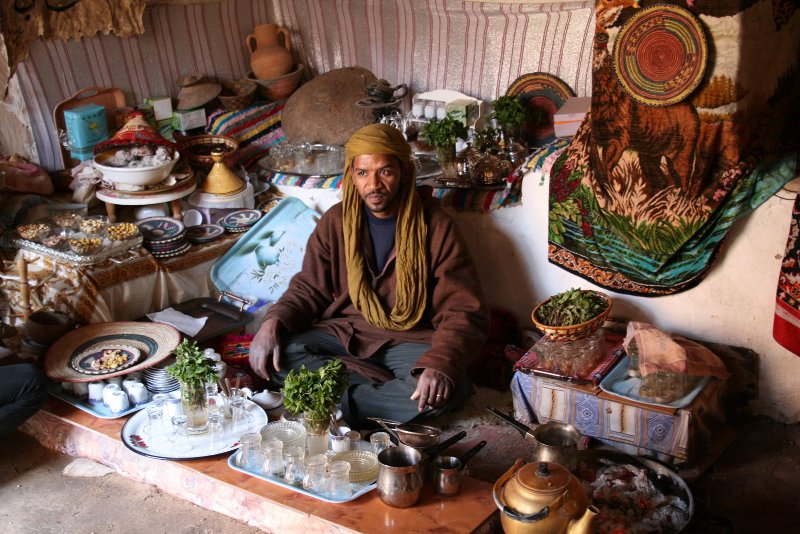
Mint for tea and a banquet of nuts and traditional Saharan finery surround a man of Ghadames (anciently a town of the Garamantes). He looks ready to host many guests

     These names are probably recalled by the ethnonyms of modern  Nilo-Saharan speakers of Fezzan, Libya, Chad and the Sahel who are still called Koroma, Djerma or Zarma, the N'gam, N'galagha, and Teda or Tida-Krit or Kareda.  Some of the ancient and present "black" populations of Fezzan and Libya now  classified as Toubou or Tibbu themselves appear to have been derived themselves from several ethnic sources of both Nilotic, Saharan and Cushitic origin.

 
Modern Zaghawa man called Zuwagha in Sudan and North Africa
                                          
        Teda, Zaghawa and Daza groups each speak Nilo-Saharan dialects, but claim and appear to have had separate origins. The Teda-Goran or Daza are known to be a rather war-like people whose women even wear daggers under their sleeves. Cabot -Brigs in 1962 wrote, “women sometimes wear swords and armdaggers, and exercise a freedom and a degree of authority which suggest that they may have enjoyed a higher status in the past.” They also have a group of people who are slaves called Kamaya.

Women of the Teda (Tubu)  perform a dance (photo from the site tribal-bellydance.be)
http://www.youtube.com/watch?v=A23mN_QjNys
See here documentary on caravan Tubu women on their annual 1500 kilometer Saharan trek to Bilma.

      One group now classified as Tibbu, or Tubu, which were apparently originally Cushitic include the Bilia, Beli-Zaghawa or Bideyat (Badai).  (Pastoralists of the West African Savannah. 1986, p. 74, and "The Tibu Peoples and the Libyan Desert", by R. F. Peel, The Geographical Journal, Vol. 100 , No. 2, 1942, pp. 73-87.) The latter who in the Byzantine era were certainly the peoples called Beliyya, Balau or Blemmyes still designate themselves Beri or Beriberi and  may have been responsible for bringing the word Berber into the Fezzan and North Africa.
         The modern Tibbou or Teda-Krit, Kreda, are also called Ikaradan, Kardawan and further west as Haratin.  The Haratin further west however often present an appearance especially in the top portion of the face that is between San (so called Hottentot or Bushmen) and Beja.  On the other hand this may have been later Turkish influence, as there is frequently a similar appearance to the eyes among other Moroccan Berbers.  These groups are likely representative of the ancient Tidamensi of Fezzan who have been described by early historians as a branch of the Garamantes. They are related to the original Azghar or Izaggaren of Tassili who were vassal clans of the Tuareg. It was a man named Augustus Keane who first noted that "there were two distinct sections of the Tibbu one the northern Tedas, a name recalling the Tedamansii a branch of the Garamantes...". The other group may descend from the "Ethiopian Trogodytes" that were captured as slaves, such as the Teda still possess. (MacMichaels, 1922,  p. 31). The Garamantian tribe was also said to have been also associated with the town of Ghadames. Some have even  speculated more recently that Cidamus the Roman name for Ghadames was somehow a corruption of Tidamensii (an idea which probably has little to support it).
     Modern study has found the Haratin blood groupings to be the closest to the ancient Egyptians of any living African population and they are undoubtedly among the most ancient populations of the Sahara who were also likely settled on the Nile and east of by the neolithic era. ( Paoli, G., "ABO Typing of Ancient Egyptians" found in Population biology of ancient Egyptians  1973, p. 464.)

A modern Haratin family

      The Garamantes were cattle herdsmen or pastoralists, but skilled in hydraulics and agricultural, metallurgy, glass-making and mining and used high-quality textiles. They were also developed expertised in salt-refining.  Their advanced irrigation and hydraulics technology allowed them to create a green oases in the midst of the Sahara. They had many walled towns and built pyramids and pyramid funerary monuments with Meroitic Nubian affinities. Their advanced irrigation and hydraulics technology allowed them to create a green oases in the midst of the Sahara.
      According to Charles Daniels in his groundbreaking, The Garamantes of the Libyan Sahara (1970), the type of cist burials they used which are the most ancient cairn type found throughout the northern Sahara were associated with "hollowed stone bowls reminiscent of those found in the southeastern Sahara" (pp. 32-35). They buried there dead in contracted fashion typical of Africans of the Sahara, the Nile and east Africa at that time and during the neolithic and skeletons were found covered with red ochre.
       Other populations of the modern Toubou may descend from the "Ethiopians" called Trogodytae who made their homes in caverns and dwelt both in Sahara and near the Red Sea. Herodotus mentions the Garamantes who though they were not war-like, hunted from four horse chariots the trogodyte Ethiopians who lived in caverns and sounded like bats. The Tibu or Toubou graves are reminiscent of  those found among the Zaghawa of Dar Fur, but they date back to an very early period in the Sahara and Nubia as well. 
       The Amazonite mined in the Acacus region of Libya known anciently in Egypt as the Tmhy stones is still extracted by the Toubou there, which has led some to suggest that some of the Toubou-speakers descend from the ancient Temehou people of the Libya and oases adjacent to the Nile. (p. 54, Willis, J.R.,  Slaves and Slavery in Muslim Africa)


The Toubou of Africa dwelling in Chad, Fezzan, Sudan, Libya, Niger


“There are three tribes of Ethiopians: Hesperians, Garamantes and Indians”, Isidore of Seville, Spain 6th century.  (See IX ii 128.in The Etymologies of Isidore of Seville, Stephen A. Barney, 2006, p. 199).   


        The name of the Garamantes came from of the ahel Gara who had a town called Garama or Jerma.  In ancient Greek myth, Garamas was a brother of Ogygia or Gyges a king in the Aegean and the grandson of  Minos the ruler who founded Crete expelling the Carians a Pelasgian people from the area. The mother of Garamas,  also called Amphithemis, was Tritonis, a water nymph.  Interestingly the myth of descent from a water nymph seems to be retained among the people like the Fulani or Woodabe/Futa-be also once numerous in the neolithic Sahara and oases next to Egypt.
      Garamantians peoples once had a major civilization in the Libyan Fezzan and Sahara comprised of several towns. The civilization peaked between the 2nd B.C. and 6th century A.D.  From where the name of the Garama is derived it is not certain, but the direct roots of Garamantian culture date back to at least the 9th century B.C. and early Garamantians are described by Herodotus in the 6th century BC as a "great nation", although having no weapons of war.
     Garamantian agriculturalists may have evolved from the neolithic agriculturalists of the region. By the time the Greeks first spoke of the them they were cattle herdsmen or pastoralists, but skilled in hydraulics and agricultural, metallurgy, glass-making and mining and used high-quality textiles. They had a well developed expertise in salt-refining as well.  Their advanced irrigation and hydraulics technology allowed them to create a green oases in the midst of the Sahara. They had many walled towns and built pyramids and pyramid funerary monuments with Meroitic Nubian affinities.  They were also noted as fishermen. Shrimp being among their favorite meals.


      According to Charles Daniels in his groundbreaking work, The Garamantes of the Libyan Sahara (1970) the type of cist burials they used which are the most ancient cairn type found throughout the northern Sahara were associated with "hollowed stone bowls reminiscent of those found in the southeastern Sahara" (pp. 32-35). They buried there dead in contracted fashion typical of Africans of the Sahara, the Nile and east Africa at that time and during the neolithic and skeletons were found covered with red ochre as elsewhere.
       Other populations of the modern Toubou-speakers may descend from the "Ethiopians" called Trogodytae who made their homes in caverns and dwelt both in Sahara and near the Red Sea. Herodotus mentions the Garamantes who though they were not war-like, hunted from four horse chariots the trogodyte Ethiopians who lived in caverns and sounded like bats. The Tibu or Toubou graves are reminiscent of  those found among the Zaghawa of Dar Fur, but they date back to an very early period in the Sahara and Nubia as well. 
        Garamantians mined Amazonite in the Acacus region of Libya known.  Amazonite anciently in Egypt was known as the Tmhy stones and  is still extracted by the Toubou, which has led some to suggest that some of the Toubou-speakers descend from the ancient Temehou people of the Libya and oases adjacent to the Nile. (p. 54, Willis, J.R.,  Slaves and Slavery in Muslim Africa)


Garamantian funerary monuments built with similar techniques to those of Meroe


The pyramids of Meroe in Nubia
                 

      The traders of the Garamantes served as intermediaries between the Mediterranean coast and Africa. They traded semi-precious gems that they mined with Carthaginians as well as Romans and Byzantines.     Later on elements were introduced from further east and north. The rock art of the region shows at some point in time a script similar to the Tuareg Tifinagh was introduced as well as a people similar to the feather wearing people of Nubia  and on Libyans in Egyptian reliefs. There were Phoenician or Punic elements as well. Interestingly the Tuareg word Tifinagh is supposed to mean 'belonging to the Phoenicians", and Tuareg still claim descent from Phoenicians.
      On the other hand the Tuareg by custom are a people who hold the plough in contempt and look down on the agricultural way of life and those who live it so the idea that has been put forward by some amateur historians that the Tuareg and the originally the highly agricultural Garamantes were the same people is a highly unlikely proposition. Most likely the Garamantian population had become particularly by its later era similar to that which now inhabitants the Libyan Fezzan, the Toubou or Haratin, Zaghawa and Tuareg-related peoples, with a hierarchical society consisting of both nomadic pastoralists and sedentary peoples that included war-like nobles, vassals and slaves who performed the cultivators and metallurgical work. The Garamantes grazed their oxen backwards and bareback and had this and other customs in common with modern Nilo-Saharan inhabitants of the Bornu Saharan region.

Excavated ruins of Garama or old Jerma


      In 470 AD. the Latin poet Florus records (in scatological and racist terms) the importation of Garamantians as slaves into North Africa.  In the same era the Latin writer Luxorious notes the importation of Garamantian women and men as slaves into North Africa. (Willis, 1985, p. 55).  Lucan 4.679 describes them and the Nasamones as  perustus or 'burnt up' by the sun; Arnobius in Adversus Nationes 6.5 calls them fuscus or brown or dark.  Ptolemy II had early on referred to the Garamantes as "somewhat black" and "more likely Ethiopians" rather than Libyans. They were described as nearly nude and wore loin cloth made of animal skin like the medieval Zaghawa of Kanem. And like the latter the Garamantians had herds of cattle and possessed horses and camels, and rode their oxen backwards in pasturing. Past anthropological study of Garamantian skeletal evidence by Sergi and Charles Daniels has shown that the people were morphologically not that disimilar from types found in the Sahel, Sahara and Nubia extending into the east African area today.
       As with other early proto-Berber tribes the Garamantes and Getulians were both frequently disparaged for their black complexions in early Latin literature. A recent abstract for the article "Was Black Beautiful in Vandal Africa" in African Athena: New Agendas by professor and classicist John Starks, Jr. clarifies the issue.

"Anti-black racism appears in poems of Vandal-era Africa from the Codex Salmasianus of the Anthologia Latina. Two spottepigramme viciously attack the blackness of ‘Berber’ Garamantes from the African interior. AL183Riese labels a black man, possibly a successful athlete ..., as ‘dregs that have invaded our space,’ ‘a black homeboy (verna) that loves his pitchy skin,’ an inhuman specter so dreadful that Dis should hire ‘the ink-blackened monster’ to guard the doors of Hell. Luxorius 329R calls black Garamantian women ugly and white Pontic women beautiful indicating apt local color in his West-East geographical twist on the South-North Greek racial dichotomy of Ethiopians and Thracians/Scythians (Xenoph. fr.16Diehls)."
   In actuality the ancient writings about Garamantians sound strangely contemporary in its racist aspects as we find their skin color - which was likened an ink blot here and to tar by Plautus  - was also vulgarly compared at times to fecal matter in some writings.(See African Athena: New Agendas, 2011,  p. 247.)
     Another translation is as follows:  "dregs of the Garamantes and the scay visage of a black slave who looks as if he should be a guard at the gates of Hell. But it also allows that the slave, homegrown as he is, took pride in his pitch-black body" (Gruen, Erich S., 2011, p. 206).
    Directly west of the Garamantes were the Getulians, the most numerous people of North Africa or what was then called Libya (Mela, lib. I. c. 3; Eustathius, Commentarii in Dionysium, v. 215).  Starks also mentions what Luxorius wrote seemingly about the Getules.
"Luxorius praises white, feminine beauty in classic terms (364R), but with stronger cultural relevance in tributes to the white Vandal women among his ruling-class patrons (18R.36-7; 345R.6; George). By contrast, he castigates the dancer Gattula (361,362R), whose name may suggest Gaetulian heritage (Rosenblum; Melanogaetuli Ptol. 4.6.5) and her blackness (gattula/francolin-black partridge TLL 1629), as the epitome of horrifying ugliness, an ominous evil who disgusts audiences with her gyrating body and attracts only corpses with the fruits of her success. Blacks in Vandal Africa are only participants in the ‘freak show’ of exotic animals and disfranchised societal infames, entertainers, sexual deviants, the disabled, the ugly as constructed by a reconstituted Roman society self-realized between white Vandal power and black African marginalization."
     The Getulii were anciently known as the inhabitants of southern Numidia and certain writers name them or  a portion of them the Melano-Gaitules or "black Getuli" - Getuli being either the name of a snake or partridge. The Roman writer Juvenal comically speaks of a Getulian or "a Moor" "so black you'd rather not meet up with him at night time". (Juvenal Satires 5.53-4). 
     Starks also writes,  "Juvenal's black Gaitulian Ganymede is a drover ill-equipped to serve as cupbearer, and polar opposite to a lily-white Asian pansy (flos Asiae), the stereotypical do-nothing 'eye candy' slave of opulent Roman households" (Starks, 2011, p. 253).
       Ancient writers in fact make clear the original Getulians were an extension of the nomadic occupants of Nubia and the Blue and White Nile rivers in east Africa or Sudan. The first century Roman Jewish writer, Josephus, asserts in his Antiquities of the Jews, in a section on the children and grandchildren of Ham that the Getuli were descendants of the "Evileans" or Evalioi (Havilah). As far as he was concerned they belonged to the same people that had not only settled Meroe and parts of Western Ethiopia - i.e. the Sahara and Sahel, but who had once occupied Syria or Canaan and Babylonia.
      He asserts, ''The children of Ham possessed the land from Syria to the Amanus and the mountains of Libanus, seizing upon all that was and the seacoasts, and as far as the ocean and keeping it as their own. Some of its names are utterly vanished away..."
     Continuing he speaks of the grandchildren of Ham, "Sabas [Sabax], who founded the Sabeans; Evilas [Havilah], who founded the Evileans, who are called Getuli ..." and "Sabathens who are now called by the Greeks Astaborans". He goes on to speak of Ragmus (Ra'amah) ancestor of the Ragmeans, and Yudadas or Judadas (or Dedan) who settled the  "Judadaeans, a nation of western Ethiopians and left them his name, as did Sabas the Sabaeans." 
       Josephus adds "but Nimrod the son of Chus (Kush) stayed and tyrannized at Bablyon as we have already informed you."  Of course Dedan or Yudadas, Hevilah, Ragmah and Sabas spoken of are the Dedan, Saba, Hevilah, Ra'amah, Nimrod and Sabtah named the sons of Kush, son of Ham in Genesis 10:7  and 1Chronicles 1:9 of the western Bible.  In those days Kush appears to have been the name of an area on both sides of the Red Sea.  In Africa it was south of Egypt.  The Arabian Tihama was referred to as Kush according to the medieval write ibn Mudjawir. At one time "at least the southern Tihama (from Mecca southwards) was called Kus (Ibn Mugawir, Tarikh, 83)." (See Jean Retso's, The Arabs in Antiquity, p. 231, 2003, note 52.)
        The geographies of Ptolemy and Strabo of the same era as Josephus say the Sabaeans were the occupants of Meroe. He describes the nomads wandering with their herds called Astaborans who occupied and named the Atbarah in the modern country of Sudan and the Astapus (White Nile) both rivers which insulated the Meroeitic area. The ancient Evalioi or historical Avalites were related people who were great traders of incense between Eritrea, Somalia and the Arabian peninsula named the city of Zeila or Zawila or Dthu Awilah on the gulf of Aden in northwest Somalia. Strabo names the Sinus Avalites to the south of the Straits of Bab el-Mandeb.
     According to the notable 12th century traveler Benjamin of Tudela (a locale of Spain), the Zeila or Zawila in the Libyan Fezzan was also designated Havila, and capital of the land of Ghana. He writes,  "From Assuan it is a distance of 12 days to Haluan (Helwan in Egypt near Cairo), where there are about 300 Jews.  Then people travel by caravan a journey of 50 days through the great desert called Sahara to the land of Zawilah which is Havilah in the land of Gana"  (Adler, 1906, p. 678). This land also known as Avalis was in medieval times named Zeila Uzlan or Wasilah from which Palmer thought came the Roman word Sylli or Seli or Silha (H.R. Palmer, Tuareg of the Sahara I, 1932). The region was colonized by Turks in a the late medieval period and is now called Murzuk.
      Among the ancient Gaitules were included the Autololes once spread over the coast of Mauretania Tingitana (Tangiers), Bagigaituli  and the Darae Gaituli on the steppes of the Upper Atlas or Grand Atlas who are said to have named the valley of the Draa or Wedh/Wadi Dra'a. The "Getulians, distinguished by the designation of Darae have left their name to Darah, separated from Morocco by a branch of Mount Atlas". According to the recent publication, Travel Morocco: Guide Maps and Phrasebook, the modern inhabitants are called "Drawa" and "Outside of the Draa region this name is mostly used to refer to the dark-skinned people of Draa which make up the largest portion of its inhabitants.(Travel Morocco: Guide Maps and Phrasebook, 2010)
     
Modern Berber girl of the Wedh Dra'a


      From the Gaitules arose a considerable portion of the clans that appear to have included the Zanata Berbers whom according to Ibn Khaldun were the most considerable of the Berbers of North Africa.  These Zanata or Zenetes included the Magherawa anciently called Machurebii in Algeria (Makhoraba and Makhorenes in Nubia) "who were on the northern side of the Daradus or the modern Wadi Darah" (Cooley, 1841, p. 58, fn. 98). In the middle of the 11th century, the Maghrawa still "controlled most the Sous and Drâa, Sijilmassa, and Aghmat as well as Fès."  Idrisi refers to them as Maghrewat es-Sudani. They are the ancestors of the Imaqqaren or Imagharan Tuareg who also founded Tin Bakht or Timbuktu. The name of the Gaitules is also thought to have evolved into the Joddala branch of the Sanhaja who were known in part were represented by the Fulata or Fulani known as Banu Warith or Barzu Fulitani of Mauretania Caesarea. 
      Another branch of the Zanata were the Jarawa or Jawara whose descendants are thought to be the Ghuara or Guara of Wargla, Touggourt and the same as Garawan or Goraan populations of Fezzan and Chad. These people are the descendants of the Garamantian traders early on whose centers were the northern oases stretching between Algeria, Tunisia  and Libya.
     As they moved southward into the Sudan they became known in manuscripts as Wangara or Wakore. As Bovill states in Silent Trade of Wangara, these traders were known in the western Sahel and Sudan as, “Wangara and Sarakore (Sarakolli), and in the east as Kardawan and Garawan (Garamantes)…” (Bovill, 1929, ). The town of Jerma is later in fact called Karran or Garan after the Gorane or Garawan population still extant there.
      In the 6th century the leader John Troglita a general of Roman Africa had taken captives of the Mauri of Aurasium which Corippus had said were "black as crows". These Mauri were doubtless the Djarawa or Garawan some of whom had come to live in the Aures and were to make up according to "a huge proportion" of the Zanata Berbers according to Taha. In the 7th century their famous female leader al-Kahina "chief of the Djarawa"  in the Aures mountains in Tunisia had assembled all the Zanata of the region and swore to throw out all of the Arabians from Ifrikiya.  She was very much disturbed that Kusayla the Sanhadja (Tuareg) chieftain had imposed his rule over the region next to hers, had become powerful and then been defeated by the Arab newcomers. It is said by Ibn Khaldun and others that Kahina was a prophetess and priestess and that her people were of the Jewish or Hebraic faith.
      Norman Solomon, in the book, Judaism (2009), speaks of this “fearsome” Berber “princess” who’s citadel was at Bijaya or Bougie in Algeria which was also home to a considerable Vandal settlement. He states, “In what is now southeast Algeria was a powerful Berber tribe, the Jerawa, which had become Jewish. With Kahina at their head, the Jerawa defeated the Arab army of Hasan al Nu’man, holding up the Arab invasion of Africa and preventing its further progress into Spain” ( p. 44). 
     One thing that links many of the Zanata confederation of clans or kabilas together is the early tradition of being largely Judaized or Jewish.  "The Jewish Ifren Maghrawa" were in the Medieval period settled at Wargla and other places in the Maghreb (according to E.J. Brill's First Encyclopaedia of Islam, 1913-1936, Vol. 9, p. 1123)  The Maghrawa rule in Fes was seen as the golden age of Moroccan Judaism. (Park & Boum,  2006, p. 225). The book Two Thousand years of Jewish Life in Morocco or (Deux Mille Ans de Vie Juive au Maroc) that  in the valley of the Dra'a there had existed for a long time a linked conglomeration or chain of important Jewish communities that had existed for a long time.
       In addition the other major branch of the  Zanata Berbers called Nafousa are referred to by Ibn Khaldun as having been Jewish at the time of the conquest by the Arab Hassan al Nu'man (Sand, 2010, 202). The "brown skinned Ghuara" occupied the whole basin as far as beyond Tuggurt "wrote French adventuress Jean Pommerol at the turn of the 20th century.  “Tuggurt, a brown coloured town, inhabited by Ghuara, is very like Wargla in appearance” (Pommerol, 1900, p. 233, 241, 245).  In W.B. Hodgson’s translation of “Notes of a journey into the interior of Northern Africa” by Hadji Ebn ed-din el Eghwati we read: "Ghadames is a large town...the inhabitants speak the Berber language...Their complexion is black." Elsewhere it says, “The color of the population of Tuggurt is black, and they are called Erwagha" (Hodgson, 1831, pp. 18 and 22).  
        The Wargla oasis of the M'zab was apparently said to have been occupied by the ancient Garamantes in the time of Sallustius (Pommerol,  1900, p. 232) who refers to the people there as such. The descendants of the ancient Garamantes are now called the Ghuara, and occupy the Wadi Mia and the whole basin of the Wad Rir (Rig), as far as beyond Tuggurt (Pommerol,  1900, p. 232). Stefan Goodwin recalls the writings of Africanist George Murdock on the early peoples of the region of Mzab and other Saharan oases:  “Some records from classical antiquity indicate that oases as far north as Gadames in Tunisia and Guarara, Tuggurt and Wargla in Algeria were inhabited preponderantly by ‘black’ Africans with woolly hair who apparently were indigenous to the central Sahara and northern Africa at this time…”

Ghadames - ancient town of the Garamantes in the Libyan Fezzan
"Ghadames is a large town...the inhabitants speak the Berber language...Their complexion is black." From Notes on a Journey into the Interior of North Africa" W.B. Hodgson


Touggurt home of the Ghuara (or Jawara) Berbers

“Tuggurt, a brown coloured town, inhabited by Ghuara, is very like Wargla in appearance” (Jean Pommerol, Among the Women of the Sahara, 1900, p. 233, 241, 245)


       Robert Brown in his notes explaining Leo Africanus writings on Wargla (Ghuargela)  also claimed of  “Wargla and Tuat ” that  “the black races originally occupying those Saharan oases (were) driven south” only  “with the coming of the Libyan Tuareg” (Brown, 1896, p. 217  fn. 78).   The descendants of these Saharan commercants and traders Wangara or Songhai were said to have founded and ruled Ghana and Songhai  and Dar Tichitt.


Ghardaia in Mzab founded by Jewish Berbers turned Ibadites or Abadites fleeing Wargla


     The Ibadite Maghrawa fled to Ghardaia which they founded “Righ or Arigh derives its name from the Righa Berbers a group of the Maghrawa Berbers  belonging to the great Zenata family.”  (Lewicki, 1988, p. 154).
      
      Legends had it that Wargla was was built by King Solomon of Jersualem who was master of the winds and clouds and that the Queen Makeda of Sheba considered to be Candace of Nubia would often visit. (Pommerol, 1900, 230, 232). The Zaghai or Songhai traders claimed their ancestral dynasties to have come from Wargla of the M'zab region as well.  Interestingly Arthur Godbey in 1930 and earlier coloniliast observers spoke of  the inhabitants their saying, “in the Wargla Oasis of Algeria, 350 miles from the Mediterranean, is a colony of Jews ‘as black as Negroes'" (See also John Beddoe, On the Physical Characteristics of the Jews, Transactions of teh Ethnological Society of London, Vol. I. 1861, p. 234 ).
 
      The writer of Hebrewism of West Africa (1999) wrote what one documenter wrote of the Jews of Wargla and Mzab:
 "The most interesting is the group of Berber heretics called (Abadites) who in the 10th century fled from Mussulman. They established themselves in the desert and to this day have the most mysterious rites and customs.  Slouchz is of the opinion that these Jews of Mzab have best preserved the customs and manners peculiar to the Jews of Africa. He quotes the opinion of Dr. Huguet: 'The type of Biblical Jew has been preserved to a remarkable degree among the Jews of M'zab, and adds  'And indeed, in all of the district of the Sahara from Tripoli to Dra'a, the traveler could easily imagine himself transported into an ancient Jewish colony - a very primitive agricultural colony, for it has neither Cohaniim or Leviim, nor any written traditions. For many centuries these were the counterpart of the Jewish pre-Islamic settlements of Arabia, and today they are a marvelous survival of the Israel epoch of the Judges in the Wastes of the Great Desert.'" p. 209
Man of the town of Gourara north of Tuat - home of the Zanata Berbers
  
"The descendants of the ancient Garamantes are now called the Ghuara, and occupy the Wady-Mia with the whole of the basin of the Wady-R'ir, as far as beyond Tuggurt"  Jean Pommerol Among the Women of the Sahara (1900) p. 232.
 

  To be continued in Part II -  Zaghawa, Songhay, Wangara link to the emergent states across the Sudan...


See also the unique new blog - http://greatafricanists.blogspot.com/

Abun-Nasr, J. (1987). A history of the Maghrib in the Islamic period. Cambridge University Press.

Barthelemy, A. (1987). Black faced maligned race: The Representation of Blacks in English drama
            from Shakespeare to Southerne. Louisiana State University Press

Bovill, E.W. (1929). The Silent Trade of the Wangara.  Journal of the Royal African Society, 29(113),
                    pp.27-38

Daniels, C. ( 1970 ) The Garmantes of southern Libya. Oleander Press.


Godbey, A. (1930). The lost tribes a myth: Suggestions towards rewriting Hebrew history. Durham, NC: Duke University Press.

Gruen, Erich S., (2011). Rethinking the Other in Antiquity. Princeton University Press.

Lewicki, T. (1988). The role of the Sahara and the Saharians in relationships between north and south. In Muammad Fāsī & Ivan Hrbek (Eds.). Africa from the Seventh to the Eleventh Century, (pp. 276-313) UNESCO. International Scientific Committee for the Drafting of a General History of Africa.

Pommerol, J. (1900).  Among the women of the Sahara.  

Retso, J. ( 2003 ).  The Arabs in antiquity: Their history from the Assyrians to the Umayyads. Routledge

Sands, S.  (2010). The Invention of the Jewish race. Resling.

Starks, J.H. (2011).  "Was Black Beautiful in Saharan Africa" in African Athena New Agendas

Williams, J.J.  (1999).  Hebrewisms of West Africa. Black Classics Press. (Reprint) 


BLOGPOST COMING  SOON!  - MOORISH SETTLEMENT OF MEDIEVAL EUROPE


Modern Algerians


Spanish rendition of the 1237 Battle of Puig  - Valencia (Balensiya)  Spain (Almohad "Moors" and Spaniards). Painted by Marsal/Marcelo de Sajonia (Saxon) between 1393 and 1410 


(Please feel free to make copies in case anything disappears. There are many people that publish, or copy and paste the information from this blog onto other sites. However, as a person with multicultural interests and background, I would appreciate if the above text is not copied and pasted under pseudonyms or anonymously to other web-sites in combination with trading curses or using abusive words with other individuals, or else, verbally insulting, denigrating, or attempting to dehumanize various ethnic groups, i.e., "white people", Europeans, "Arabs", " Jews", "Turks", Israelis, etc.  Please do not modify or add to text directly copied or taken from this site. Thank you in advance for your consideration. : )